Best Body Placements for Sound Wave Tattoos
Choosing where to place your sound wave tattoo is just as important as the audio you choose. The shape of a waveform, whether linear or radial, interacts differently with each part of your body. The right placement enhances the design. The wrong one can distort it or make it hard to read.
Here is a breakdown of the most popular placements for soundwave tattoos, with practical details on visual impact, pain level, sizing, and how well the waveform works in each spot. For the full process of getting a sound wave tattoo, see our complete guide.
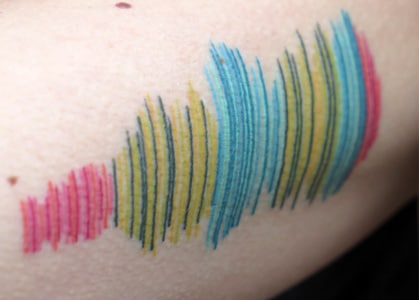
Inner Forearm
The inner forearm is the single most popular placement for sound wave tattoos, and for good reason.
- Visual impact: Excellent. The forearm provides a long, flat canvas that is perfect for linear waveforms. You can see it yourself and show it off easily.
- Pain level: Moderate. The inner forearm has thinner skin than the outer side, so expect some sensitivity, but it is very manageable for most people.
- Recommended size: 4 to 10 inches long, 1 to 2 inches tall. This gives the waveform room to breathe without overwhelming the space.
- Waveform fit: Linear waveforms sit naturally here. The slight curve of the forearm adds a subtle organic feel without distorting the design.
Wrist
The wrist is ideal for smaller, more delicate soundwave tattoos.
- Visual impact: Subtle and personal. Wrist tattoos are easy to cover with a watch or bracelet but visible when you want them to be.
- Pain level: Moderate to high. The skin is thin and close to bone and tendons. Short sessions are recommended.
- Recommended size: 2 to 4 inches long. Keep the waveform compact. A short audio clip of 3 to 5 seconds works best here.
- Waveform fit: Works well for short phrases like "I love you" or a brief musical hook. Avoid overly detailed waveforms at this size since the bars can blur together over time.
Ribcage
The ribcage offers a large canvas for dramatic sound wave tattoo placements.
- Visual impact: Striking. Rib tattoos are usually hidden under clothing, making them feel intimate and personal. When revealed, they have a strong visual presence.
- Pain level: High. The ribs are one of the more painful spots due to thin skin over bone and proximity to nerve endings. Expect a longer, more intense session.
- Recommended size: 6 to 12 inches long. The ribcage has enough space for longer audio clips and more detailed waveforms.
- Waveform fit: Linear waveforms flow beautifully along the ribs, following the natural curve of the body. Horizontal placement following the line of the ribs is most common.
Upper Arm and Shoulder
The upper arm and shoulder area works particularly well for radial or circular sound wave designs.
- Visual impact: Bold and visible in short sleeves. The rounded shape of the shoulder naturally complements circular waveform designs.
- Pain level: Low to moderate. The outer upper arm is one of the least painful spots for tattoos. The shoulder itself is slightly more sensitive.
- Recommended size: 3 to 5 inches diameter for radial designs, or 4 to 8 inches for linear waveforms wrapping around the arm.
- Waveform fit: Radial waveforms are a perfect match here. A circular design centered on the shoulder or upper arm looks intentional and balanced. Linear waveforms can wrap around the arm as a band.
Behind the Ear
A poetic placement for a sound-related tattoo. The connection between sound and the ear makes this placement conceptually satisfying.
- Visual impact: Subtle and clever. Easily hidden by hair but visible when you want it to be. The placement itself tells part of the story.
- Pain level: Moderate to high. The area behind the ear is sensitive, and the buzzing of the tattoo machine is very close to your ear, which some people find uncomfortable.
- Recommended size: 1 to 2 inches. This is a micro-tattoo spot, so keep the waveform very short and simple.
- Waveform fit: Only works for very short clips, a single word or a heartbeat. The waveform needs to be simple enough to remain legible at this small scale.
Spine
The spine is a unique placement that uses the vertical axis of the body for a sound wave tattoo.
- Visual impact: Dramatic and elegant, especially on exposed backs. The vertical orientation is unexpected for a waveform and draws attention.
- Pain level: High. Tattooing directly over the spine and vertebrae is consistently rated as one of the more painful experiences.
- Recommended size: 6 to 14 inches long. The spine provides a long vertical canvas.
- Waveform fit: A rotated linear waveform running vertically down the spine creates a striking effect. The symmetry of a waveform mirrors the symmetry of the spine itself.
Collarbone
The collarbone is a popular spot for those who want their soundwave tattoo to be visible in lower necklines.
- Visual impact: High. Collarbone tattoos are visible in V-necks, scoop necks, and off-shoulder tops. They frame the neckline naturally.
- Pain level: Moderate to high. The skin is thin and the bone is close to the surface.
- Recommended size: 4 to 7 inches, following the line of the collarbone.
- Waveform fit: Linear waveforms follow the gentle curve of the collarbone beautifully. The natural slope adds character to the design.
Ankle
A compact, discreet option for a small sound wave tattoo.
- Visual impact: Low-key. Ankle tattoos peek out above shoes and sandals. They are easy to hide with socks or boots.
- Pain level: Moderate to high. The ankle has thin skin and little fat over bone.
- Recommended size: 2 to 4 inches, wrapping around the ankle or placed on the inner or outer side.
- Waveform fit: Short linear waveforms work best. A waveform wrapping around the ankle like a bracelet is a creative option if the audio clip is the right length.
Tips for Choosing Your Placement
- Match the waveform type to the body shape. Linear waveforms suit elongated areas (forearm, ribs, spine, collarbone). Radial waveforms suit rounded areas (shoulder, upper arm, back).
- Consider aging. Areas with less sun exposure and less stretching over time (inner forearm, upper arm, ribcage) tend to hold fine-line tattoos better.
- Think about visibility. Do you want to see it daily? Forearm or wrist. Want it to be personal? Ribs or spine. Want it to spark conversation? Collarbone or behind the ear.
- Test with a temporary print. Export your waveform from SoundViz and have your tattoo artist create a temporary transfer to test the placement before committing.
Browse 25 sound wave tattoo ideas for inspiration on what audio to use, then create your sound wave design free on SoundViz. Once you have your exported waveform, bring it to your chosen artist for a placement consultation. Seeing the design on your body before the needle touches skin is the best way to ensure you love the result.