Memorial Sound Wave Tattoos: Preserving a Loved One's Voice Forever
Losing someone you love leaves a silence that nothing can fill. But sometimes, tucked away in your phone or buried in old videos, there is still a piece of their voice waiting for you. A memorial sound wave tattoo takes that voice, that laugh, that "I love you," and transforms it into something you can carry with you always.
This is one of the most meaningful uses of sound wave art. It is not just decorative. It is a way of holding on to someone. And for many people, the process of creating the tattoo becomes part of the healing journey itself.
Why Voice Recordings Matter So Much
After someone passes away, their voice is often what people miss most. A photograph captures how they looked. A voice recording captures how they sounded, how they laughed, the specific way they said your name. That is something a voice recording tattoo preserves in a way nothing else can.
The most common sources for memorial waveforms are:
- Voicemails. The single most common source. Many people have a saved voicemail from a parent, grandparent, or friend who has passed. That 10-second message can become the most meaningful tattoo of your life.
- Video clips. Home videos, phone recordings, social media videos. Even a short clip of someone speaking or laughing contains usable audio.
- Voice memos. If they ever sent you a voice message through text or a messaging app, that audio can be extracted.
- Old answering machine tapes. These can be digitized and used to generate a waveform.
What Phrases People Choose
When selecting the specific audio for a memorial tattoo, people tend to gravitate toward short, meaningful moments:
- "I love you" - The most popular choice, and understandably so. Hearing those words in a loved one's specific voice is irreplaceable.
- "I'm proud of you" - Parents and grandparents say this in ways that stay with us forever.
- Their laugh - A person's laugh is as unique as their fingerprint. It often captures their personality better than any words could.
- "Hey, it's me" - The casual opening of a voicemail. So ordinary in life, so precious after loss.
- Their name for you - A nickname, a pet name, the specific way they pronounced your name.
- A prayer or blessing - For those with spiritual traditions, a recorded prayer or blessing carries profound meaning.
- Song lyrics they always sang - If they had a signature song, the waveform of them singing it combines music and memory.
The Healing Process
Creating a memorial sound wave tattoo is an emotional experience. Many people describe it as both painful and cathartic, not because of the needle, but because of what the process requires: listening to that voice again, sitting with the grief, and then choosing to carry it forward as art.
Christina Humphries, a SoundViz user, turned a treasured voicemail into a waveform to keep her loved one's voice close. Stories like hers remind us that these tattoos are not about looking back. They are about bringing someone forward with you into the rest of your life.
Some tips for navigating the emotional side:
- Take your time choosing the clip. Listen through your recordings when you are in a calm, comfortable space. There is no rush.
- It is okay if the audio is not perfect. Background noise, a cough, a pause, these imperfections are part of who they were. The waveform will be beautiful regardless.
- Involve others if it helps. Some people create the waveform with a sibling, partner, or friend for emotional support. Others prefer to do it alone as a private moment.
- The tattoo session itself can be emotional. Let your tattoo artist know the significance of the piece. Good artists understand and will give you the space you need.
How to Get the Waveform File
The technical process is straightforward, even if you are not tech-savvy:
- Find your recording. Check voicemails, videos, voice messages, and cloud backups. Ask family members if they have recordings you might not know about.
- Extract the audio if needed. If the voice is in a video file, you can extract the audio using a free tool like Audacity or an online converter.
- Trim the clip. Isolate the specific phrase or moment you want. For tattoos, 3 to 10 seconds is ideal.
- Upload to SoundViz. The editor will instantly generate a waveform from your audio. You can adjust the style, but many people choose a clean, simple black waveform for memorial tattoos.
- Export the design. Download as a high-resolution PNG or SVG to bring to your tattoo artist.
Design Considerations for Memorial Tattoos
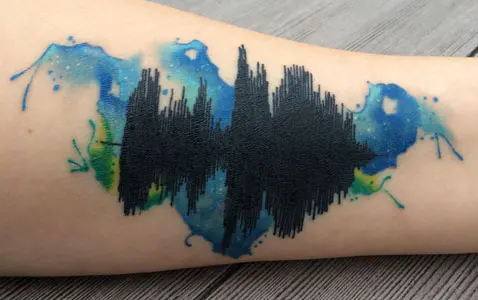
Memorial sound wave tattoos tend to be simpler and more understated than other waveform designs. The meaning does the heavy lifting, not the visual complexity.
- Black ink is classic. Most memorial waveforms are done in solid black. It is timeless, ages well, and lets the waveform shape speak for itself.
- Add context if you want. Some people include a name, date, or short phrase beneath or above the waveform. "Mom, 1952-2023" or just "Dad" in a simple script font.
- Consider pairing with other elements. A small heart, a cross, a flower, or a bird integrated with the waveform can add meaning without overwhelming the design.
- Placement matters. Many people choose the inner forearm for memorial tattoos because it is visible to them throughout the day, a constant quiet reminder. The ribcage, over the heart, is another deeply symbolic choice.
For placement details, see our complete sound wave tattoo guide.
Beyond the Tattoo
A tattoo is one way to honor someone's voice, but it is not the only way. Many people who create memorial waveforms also order framed prints or canvas artwork to display at home. Visit our memorial sound wave art page to explore additional options for preserving a loved one's voice as art.
You can also read Tyler's personal story about his sound wave tattoo of "Let It Be," which was inspired by his mother singing to him as a child. Every sound wave tattoo carries a story. Yours will too.
Create Your Memorial Waveform
Create your sound wave design free on SoundViz. Upload the recording, see the waveform take shape, and export a file that your tattoo artist can work with. The voice may be gone from the room, but it does not have to be gone from your life.